

Quick answer
A 4 days desert tour from marrakech to merzouga typically follows this pattern: Day 1 crosses the Tizi n'Tichka pass to Aït Benhaddou and Dades Valley (330 km, 7-8 hours). Day 2 continues through Todra Gorge to Merzouga for sunset camel trekking and a desert camp night (230 km, 5-6 hours). Day 3 explores the dunes at sunrise, visits nomadic communities, then returns toward Dades or Ouarzazate. Day 4 completes the return to Marrakech. The tour operates year-round with no entrance fees for the Sahara itself.
The journey to Merzouga exposes travelers to three distinct Moroccan ecosystems in a single crossing: alpine passes above 2,260 meters, river-carved gorges, and the open sand seas of Erg Chebbi. The 4 days desert tour from marrakech to merzouga divides the 560-kilometer outbound route into two driving days, allowing time to photograph the UNESCO-listed Aït Benhaddou ksar and walk the palm groves of Skoura without the compression of faster two-day itineraries. Day one's drive crosses the High Atlas via the Tizi n'Tichka pass, descending into the pre-Saharan valleys where kasbahs line ancient caravan routes. The overnight stop in Dades or Boumalne positions groups within two hours of Todra Gorge, a 300-meter canyon that anchors the second day's route. From Todra, the road transitions from rock to sand as it approaches Merzouga, where the Erg Chebbi dunes rise 150 meters above the hammada. The desert camp experience occupies the second night. Camel treks typically depart two hours before sunset to reach the camp by last light, with sunrise viewings the following morning. Day three reverses the route partially, often adding stops at fossil workshops near Erfoud or Berber villages in the Todra region. The final return to Marrakech retraces the Atlas crossing, arriving by early evening. Timing the multi-day desert crossing requires coordination around seasonal temperature swings. Summer midday heat in the dunes regularly exceeds 45°C, while winter nights can drop below freezing. Spring and autumn departures balance moderate temperatures with clearer skies for photography. Most operators provide 4x4 transport, standardized camp setups with shared meals, and bilingual guides. The itinerary's pacing assumes healthy mobility for moderate walking at kasbahs and gorges, though camel trekking can be substituted with 4x4 dune access when needed. The Merzouga region itself carries no entrance fee, though the tour package cost consolidates transport, lodging, meals, and guide services. Operators price per person based on group size, with solo travelers often joining scheduled departures to share vehicle costs. Confirming the exact overnight locations and included meals before booking prevents mismatched expectations on this 1,120-kilometer round trip.
“The journey exposes travelers to three distinct Moroccan ecosystems in a single crossing: alpine passes above 2,260 meters, river-carved gorges, and the open sand seas of Erg Chebbi.”
4 Days Desert Tour From Marrakech To Merzouga: A Comprehensive Itinerary
This four-day route suits travelers seeking a comprehensive desert experience with cultural stops along the way. The journey covers approximately 560 km from Marrakech to Merzouga, with overnight stays in the Atlas Mountains, Dades Valley, and the Sahara.
Depart Marrakech via Tizi n'Tichka
Cross the High Atlas Mountains through Tizi n'Tichka Pass (2,260 m elevation), stopping at viewpoints. Reach Ait Benhaddou by midday for a guided walk through the ksar's clay architecture (1-1.5 hours). Overnight in Dades Valley.
Todra Gorge and Erfoud
Walk through Todra Gorge's 300-meter limestone canyon walls (30-45 minutes), then continue through Erfoud's date palm groves. Arrive in Merzouga by late afternoon for camel trek preparation.
Camel Trek to Desert Camp
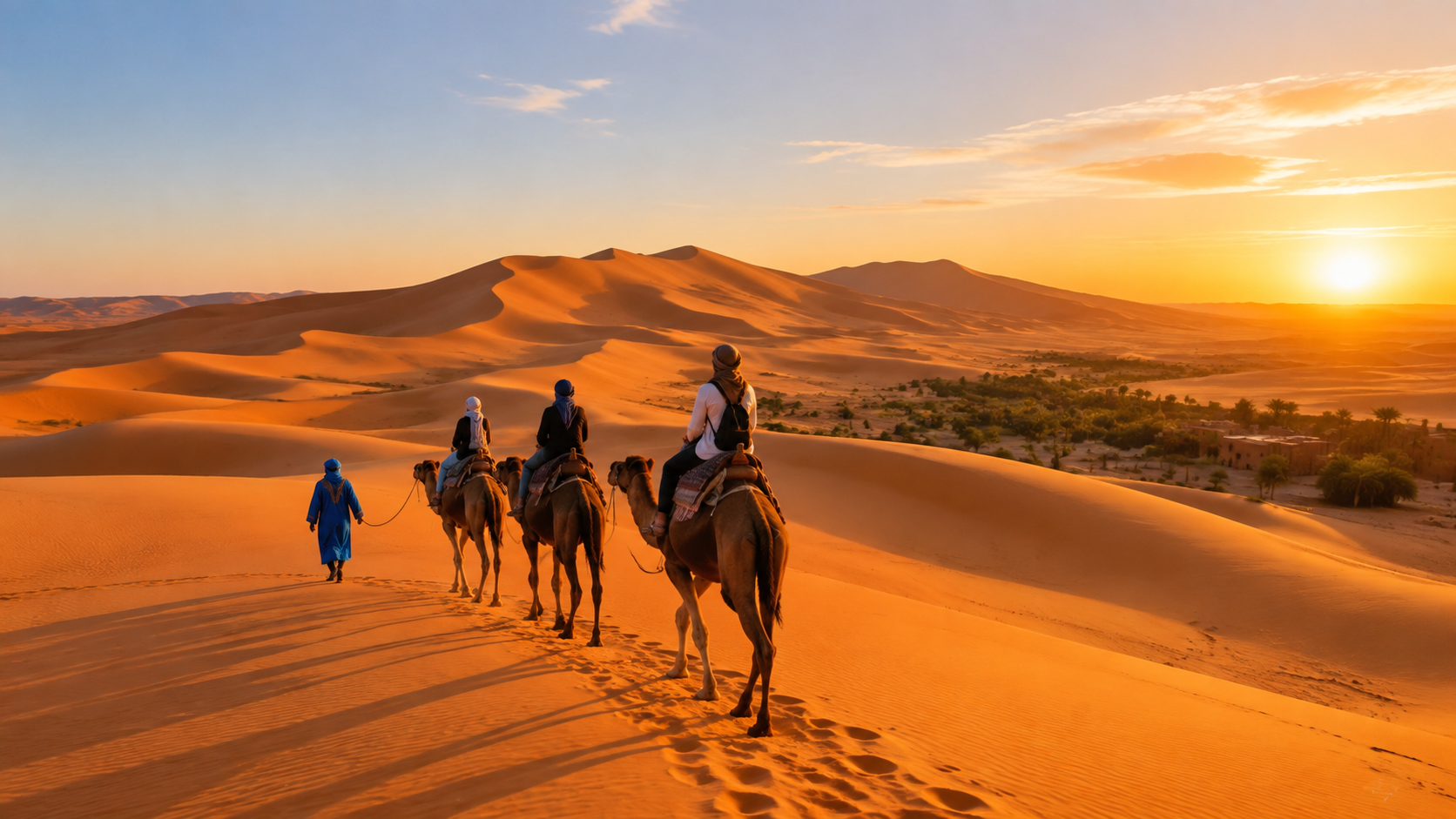
Ride camels 1-1.5 hours into Erg Chebbi dunes before sunset. Camp includes Berber dinner, traditional music, and sleeping in nomadic-style tents. Temperature drops significantly after dark.
Sunrise and Return Journey
Wake before dawn to watch sunrise over the dunes, then return by camel or 4x4. Depart Merzouga mid-morning, reversing the route through Ouarzazate and the Atlas Mountains. Arrive back in Marrakech by evening on day four.
Transportation And Arrival For Your 4 Days Desert Tour From Marrakech To Merzouga
The Sahara Desert is located in the Errachidia Province, accessible from Marrakech via a journey that crosses the High Atlas Mountains. Private 4x4 vehicles are the standard transport method to navigate the varied terrain and the winding Tizi n'Tichka pass.
N9 road via Tizi n'Tichka pass
N9 road via Tizi n'Tichka pass
Supratours/CTM line to Merzouga
Best Time Of Year For A 4 Days Desert Tour From Marrakech To Merzouga
The optimal window for a desert tour is during the spring and autumn months, specifically March to May and September to November. These periods offer moderate temperatures that allow for comfortable exploration of the dunes while avoiding the extreme heat of summer.
March–May
Moderate crowd levelsPleasant 20°C to 28°C; clear skies.
Ideal conditions for walking and photography. Spring offers mild days and cool nights before the summer heat arrives.
June–August
Low tourist densityExtreme heat; temperatures often exceed 40°C.
High temperatures limit daytime outdoor activities. Early mornings and late evenings are necessary for movement.
September–November
Moderate to highComfortable 18°C to 26°C.
Balanced weather provides the most consistent travel experience. This period remains popular for desert excursions due to stable conditions.
December–February
Low to moderateCool days; 10°C to 18°C; cold nights.
Daytime excursions are comfortable, though overnight temperatures in the desert drop significantly. Travelers should plan for cold evenings.
Verdict: The most favorable travel window is between October and November or March and April, which provides the most moderate climate for your journey.
Official Fees And Pricing For A 4 Days Desert Tour From Marrakech To Merzouga
The Sahara Desert maintains no entrance fee for visitors. Total costs for a 4-day tour from Marrakech to Merzouga are determined solely by the services provided by private tour operators.
While there is no entrance fee, travelers pay for tour packages that vary in price based on included amenities, transport quality, and accommodation standards.
Preparation Checklist For Your 4 Days Desert Tour From Marrakech To Merzouga
Prepare for extreme temperature shifts, limited infrastructure, and multi-day travel across varied terrain.
-
Book your tour operator in advance
-
Tours depart daily but fill quickly during peak months (October–April).
-
Bring layered clothing and a warm jacket
-
Desert temperatures drop to near freezing at night, even in summer.
-
Pack sun protection and a head covering
-
Daytime exposure is intense with minimal shade across the route.
-
Carry sufficient water and snacks
-
Remote stretches between Dades Valley and Merzouga have limited services.
-
Bring your passport or national ID
-
Required for hotel registration and potential checkpoint verification.
-
Prepare cash in dirhams
-
ATMs become scarce after Ouarzazate; many desert camps operate cash-only.
-
Charge devices and pack a power bank
-
Electricity is intermittent at desert camps, and mobile signals disappear past Rissani.
Operating Hours For A 4 Days Desert Tour From Marrakech To Merzouga
The Sahara Desert region is accessible 24 hours a day, seven days a week. Visitors are encouraged to plan their arrival within specific windows to optimize for environmental conditions.
| Monday | 00:00–23:59 | |
|---|---|---|
| Tuesday | 00:00–23:59 | |
| Wednesday | 00:00–23:59 | |
| Thursday | 00:00–23:59 | |
| Friday | 00:00–23:59 | |
| Saturday | 00:00–23:59 | |
| Sunday | 00:00–23:59 |
While the area remains open daily, the recommended arrival window for desert photography and heat avoidance is 06:00–18:00.
Check availability
Frequently asked questions about 4 days desert tour from marrakech to merzouga
Everything you need to know about 4 days desert tour from marrakech to merzouga